Cruising with pets: Your guide to sailing with your furry friend
Instead of leaving pets at home, more and more cruisers are choosing to take their dogs and cats with them. But how do you keep them safe and what are the rules you need to follow?
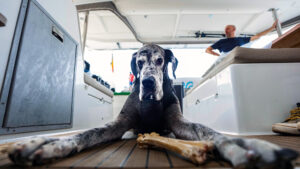
Each year, the Atlantic Rally for Cruisers welcomes crews of all ages, backgrounds, and nationalities. But there was one crewmember who attracted more attention than any other in the 2024/25 cohort: Snow, a Great Dane who made the crossing with her Belgian owners aboard a 2018 Fountaine Pajot Saona 47 called – what else? – Great Dane.
Organisers World Cruising Club believe Snow is the largest dog ever to have sailed with the ARC. Weighing in at around 160lb (72kg) from her giant paws to the top of her impressive head, she stands just over 3ft/90cm tall. She eats 800g a day of dog food – plus lots of snacks. And then there’s a special spot at the ‘business’ end of the boat…
“We get asked that a lot, where does she do her business?” says Sophie Ingels, one of Snow’s human parents, together with Sven Bruynooghe.
Sophie and Sven sold their business and travelled throughout Europe with two merle Great Danes in a campervan. Sven tested a few boats in the Caribbean and suggested they try cruising on a catamaran.
“When Sven proposed we get the boat, I said, yes, but the dogs are coming too!” recalls Sophie.
They sailed the Mediterranean for six months; when they saw that boat life actually worked with the Great Danes, they decided to join the ARC and cross the Atlantic. Sadly, one of their dogs passed away, but Snow adjusted to multihull life like a champ.

The Maltese Benji sails with Mark and Penny Belcher on their Lagoon 400 Two Hoots. Photo: James Mitchell/WCC
Practicalities
Pets on board are treated as a member of the crew. Each leg of a voyage requires specific planning, usually additional paperwork, and special provisioning. “We look at everything Benji might need quite a long time in advance,” says Mark Belcher who sails with his wife Penny and their Maltese Benji.
A rabies vaccination has to be done a certain amount of time in advance in order to prove it has worked sufficiently. In St Lucia, for example, the titer test to determine immunity needs to have been at least three months prior to arrival.
In addition, there are only certain labs whose tests are accepted by different countries, so pet owners must search out and use the specific labs that are universally accepted. In the United Kingdom, there are two labs. In the United States, there are only two or three labs.
“Other tests needed to be done in Las Palmas, because the tests need to be done within 14 days of departure – but then there’s the whole problem of getting the results back from the lab in time,” Belcher says.
Pets need a health certificate in order to get an export permit, and in turn an import permit. “We ended up with a massive file of paperwork for Benji, and we just have our passports,” he adds.
Owners should also stock up on worming (particularly heartworm and tapeworm) and tick medication. Some countries require a Lyme disease and heartworm test.
Benji, for his part, seems very unconcerned about the complicated process of preparing to cross the Atlantic. He does enjoy a really fast dinghy ride from his Lagoon 400 Two Hoots – white ears flapping in the breeze – and shows a strong interest in the cheese and ham snacks in the Canaries’ shoreside cafes.

Snow is a Great Dane who cruises with owners Sophie Ingels and Sven Bruynooghe on a Fountaine Pajot Saona 47 catamaran. Photo: James Mitchell/WCC
Paperwork
“Moving around the European Union was not difficult, but we had to deal with some paperwork to get her into Morocco. The Caribbean is more of a challenge,” notes Snow’s owner Sophie Ingels.
In order to go to St Lucia, Snow had to make three trips to the vet in Las Palmas, with blood sample tests and health reports needed. “An extensive amount of paperwork is sent to St Lucia, and they decide if Snow can come,” she adds. “Each island has different requirements and asks for different things.”
St Lucia is fairly strict and a few cruising pet owners opted for a Grenada landfall instead for an easier process post-transat. Some countries require quarantine periods, or simply don’t allow animal imports at all (for example, pets are strictly forbidden in the Galapagos).
“It’s been a nightmare,” said Sonia Johal of the red tape involved. Johal sails with her Chihuahua, Buoy, on her Hanse 385 Salacia. “To leave the UK, you need to have an export permit, then France gave us an import permit and sailing the EU was fine. But we had a hard time leaving Las Palmas. I thought I had all of the paperwork in order, from my vet. It was a challenge.
“But I love having a pet on board. I sail solo most of the time and Buoy is good company. He makes me happy, and puts life into perspective.”

Cappuccino the cat aboard Apres Ski. Photo: James Mitchell/WCC
Ship’s cat
The Smith-Haywood family on the New Zealand-flagged 1991 Tayana 47 Apres Ski, feel the same about their cat, Cappuccino.
Annika Haywood, Lloyd Smith and their two children adopted their Blue Point Himalayan in Saudi Arabia. They lived aboard Apres Ski and worked in the Middle East for 12 years on the King Abdullah University of Science and Technology program.
When they departed Jeddah, sailed up the Red Sea and transited the Suez Canal, Cappuccino handled the constant headwinds by mostly sleeping in the sun. He became a member of the EU in Cyprus and, EU passport in hand, enjoyed a five-month, 4,300-mile trip across the Mediterranean to the Canary Islands with the Smith-Haywoods. The family took in the America’s Cup in Barcelona as well as visits to Rhodes, Gallipoli, Rome, Tangier, and Casablanca.
“Each country has different rules. It’s easy to travel in and out of Europe, once you’ve met the requirements. In the Caribbean however, the French, UK and US-affiliated islands have clear procedures, but the others are more challenging,” says Annika.
Of the medical requirements for cats, rabies is the most important, requiring a certificate and vaccinations repeated every 12 months.
“Once we arrived in the Caribbean, we had our permit for St Lucia, but otherwise stuck to the French Islands to simplify things,” she notes. More paperwork followed in the US Virgin Islands, Panama, French Polynesia and New Zealand.
“We have a really nice backpack for him and have taken him on a few adventures on shore. We generally take him when we leave the boat for more than a few hours, or if we’re staying somewhere overnight.

Give your pet their own toilet area. Photo: Erin Carey
“He went swimming once, after a miscalculated jump back to our boat. We were at a marina in Greece and he was working his way down the dock jumping from boat to boat. He’s a fantastic swimmer, but a complete loony, and swam in circles around different boats. I had to get in and fish him out. We’ve since put some netting around the boat.
“Mostly he is happy wherever we are. He loves walking around the dock or around the boat at night. I am paranoid so I watch him and bring him below when we are done for the evening.
“The challenges on board are minimal for a cat. We just need to remember his food and clean out his litter.”
Safety routines
When offshore the Smith-Haywoods keep Cappuccino’s passport, rabies certificate and import permit in the overboard grab bag. In an emergency situation, Annika says, “He comes with us on the liferaft. We have a lifejacket for him right in the companionway.”
“During the transatlantic crossing he was mostly in the cockpit, sleeping in his favourite spot under the dodger where it’s always dry. But when it was food time, he would let me know.”
When Two Hoots is offshore, Penny puts Benji in his harness, then puts on her own lifejacket and takes him for a walk around the boat.
When they’re sailing, Benji’s favourite spot is in Penny’s lap and he generally sleeps in the cabin if someone’s below. “He’s so entertaining. He gives you perspective and distraction. He’s sweet and loving, and so good for morale,” Mark explains.
As a small dog he doesn’t need many provisions. “We’ve got dried dog food, and he loves salmon, tuna, chicken. We take him with us when we eat ashore.”
“He absolutely adores the beach, when we were in Greece he would run down, roll around in the water, go for a swim.”

Pets can be great company when cruising,
especially if you’re sailing short-handed. Photo: Richard Langdon
By contrast, Snow prefers to stay on board. “She doesn’t like to leave the boat,” Sophie says. “I take her out for a walk and five minutes later, she wants to come back.
“Snow didn’t get off the boat once in the Mediterranean. She does occasionally fall in, and just paddles around until we get her out.”
When they’re sailing, Snow stays under the cockpit table, secure in her safe spot. At night and in bad weather, Sven will put her inside the saloon. “She’s an ideal boat dog. If the weather is calm, she lays up front. If she sees dolphins, she barks. Sometimes at the dock or at anchor if she sees someone she howls. There’s not a lot of safety concerns for the crew when she’s around.”
The Chihuahua Buoy spends time in a small dog carrier or on lead when he’s on deck offshore, while at anchor he’s allowed to run around. “When he’s on land he becomes a bit of a puppy again. But on the boat, he pops his chest out and he’s a proper guard dog, and barks at everyone,” says Sonia.
She notes that when the crew eats dinner, he’ll get pieces of chicken but they are careful to give no sauce to ensure no garlic or onions while out of vet range. Sonia adds that having a dog on board can be great for crew morale. “When the weather’s rough, and everything’s hectic and you’re trying to sort it out, Buoy just chills everybody out.”
Rules for cruising with pets by country
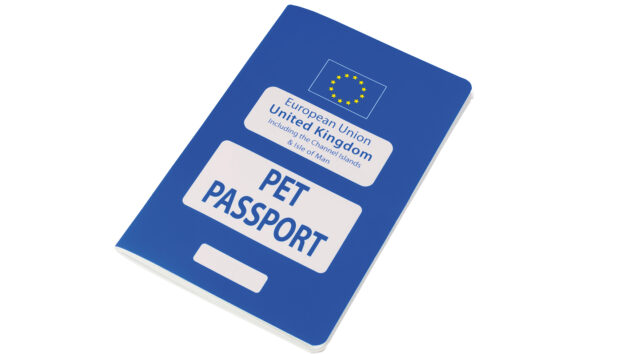
Europe – EU-issued pet passports are valid for entry into both the EU and GB, but GB-issued pet passports are no longer recognised for entry into the EU. GB residents must instead obtain a single-use Animal Health Certificate (AHC) within 10 days of every departure for the EU.
Dogs entering Great Britain from the EU must receive a vet-administered tapeworm treatment 24-120 hours before arrival. Most EU countries do not require this for entry from GB, with some exceptions (eg Ireland, Finland, and Malta).
For non-EU residents entering the EU (eg from the UK or USA), you need a Great Britain Pet Health Certificate or an EU Animal Health Certificate (AHC) issued by an official vet no more than 10 days before arrival. You must enter the EU via a designated Traveller’s Point of Entry (TPE).
Caribbean – A unique International Health Certificate and often an island-specific Import Permit is required for every country you enter. A broader range of vaccinations is also frequently required including leptospirosis, Lyme disease, and distemper, plus proof of internal/external parasite treatment just days before arrival. Most islands require a Rabies titer test.
Panama – Entry into Panama is relatively straightforward. You must submit a ‘Home Quarantine Request’ along with a copy of your passport. A valid Health Certificate, signed by an official vet (eg USDA-accredited) and endorsed by a Panamanian consulate or embassy, is required. Fees for health and quarantine officials are paid in cash upon arrival.

Baha Pelin and Kym Kierman. Photo: Baha Pelin/Kym Kierman
French Polynesia (Tahiti) – Has strict entry protocols that include a mandatory import permit obtained in advance. Dogs must test negative for leishmaniasis, and parasite treatments must be administered by a vet twice: once 30 days before departure and again four days before boarding from your last port.
Australia, New Zealand, and Fiji – Are strictly rabies-free and treat pets arriving on private vessels as ‘high-risk’ entries.
For Fiji you must secure an import permit from the Biosecurity Authority of Fiji (BAF) and provide evidence of a rabies titer test, while dogs require additional testing for ehrlichia canis, leptospirosis, and brucellosis. Most pets arriving by sea will face a mandatory quarantine of 30 days at a government facility in Koronivia. Pets must remain secured on board your vessel at all times while in Fijian waters until cleared.
Sailing into New Zealand with a pet is complex and expensive. All pets must clear through Opua, the only designated arrival port for vessels with animals. You must book a minimum 10-day stay at an MPI-approved quarantine facility. Pets are often transported by specialised taxi from Opua to the quarantine facility. Certain breeds, such as Pit Bull Terriers and Japanese Tosas, are strictly prohibited.
Australia has some of the world’s toughest biosecurity laws for pets. Arriving on a private yacht without a valid import permit is considered an illegal importation and can result in the animal being seized or euthanised. Pets must have spent at least 180 days in an approved country (like New Zealand) before entry. Pets are typically required to spend a minimum of 10 days at a post-entry quarantine facility.
 If you enjoyed this….

Yachting World is the world’s leading magazine for bluewater cruisers and offshore sailors. Every month we have inspirational adventures and practical features to help you realise your sailing dreams.Build your knowledge with a subscription delivered to your door. See our latest offers and save at least 30% off the cover price.
Note: We may earn a commission when you buy through links on our site, at no extra cost to you. This doesn’t affect our editorial independence.
The post Cruising with pets: Your guide to sailing with your furry friend appeared first on Yachting World.