
How to find the right berth for your yacht: what to look for in a marina
For many owners, finding the right berth can be almost as important as finding the yacht itself. As marinas evolve, here’s what to look for in a berth to make going sailing easy.

Finding the right berth can be one of the more challenging parts of boat ownership. Availability, location, support and cost rarely line up neatly to deliver as perfect a solution as owners would like.
The temptation is to leave the decision until later; find the yacht first, then work out where to keep it.
But where a yacht is berthed affects how often it is used, how easy it is to slip away for a short trip, how quickly problems can be sorted and how ownership feels once the excitement of buying has settled into routine. A good berth reduces friction. A poor fit may simply add enough inconvenience or delay that the yacht gets used less than it should.
Finding the right berth is about more than shelter, shore power and decent showers but instead about choosing a place that supports the sort of ownership life you actually want.
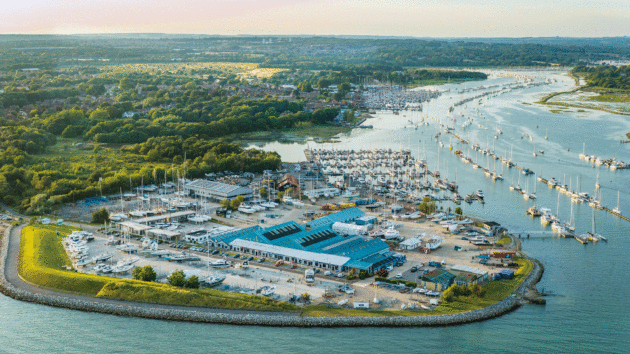
MDL’s Hamble Point Marina at the mouth of the Hamble River leading into the Solent, the South Coast’s sailing Mecca. Photo: MDL Marinas
The search
Once owners look beyond the standard annual marina contract, the berth market can appear rather different. Nic Parton of Triangle Berth Brokers has spent decades working in that gap and his role is a reminder that berths can have a market of their own, separate from the more visible marina office.
“Leasing a berth or even just finding a berth to rent can take an enormous amount of time,” he says. “People can become very frustrated with ringing around. They’ll call marina after marina, hear that there is nothing available and assume that is the end of it. Quite often it isn’t.
“People often think of a berth as something you rent year by year from a marina and that’s the only option, but there may be lease opportunities, there may be people who want to let out a berth for a time, and there may be things available that simply aren’t obvious unless you know where to look. A big part of our job is finding the berths that owners do not realise are available.”

Noss-on-Dart was developed to include high-spec shoreside facilities and a full-service boatyard. Photo: Premier Marinas
That’s where a berth broker can widen the search to find lease berths, private sublets or berth-holders with arrangements that are not being actively advertised.
“Buying a berth can actually work out much better value in the long run,” says Parton.
“In the UK, leasing is not as popular or as well-known a thing to do, but it’s very popular in the Mediterranean. In parts of the Med, people are much more used to the idea that a berth can be something you acquire for a longer term, rather than simply renting year by year.
“Plenty of owners don’t want to tie themselves to one place, but if you know where you want to keep the yacht and you know you’re going to stay there, then buying can make a lot of sense. It can give you certainty and, in the right circumstances, it can be a better financial answer too.”
Parton also points to the flexibility some lease arrangements can offer when plans change.
“We can also let out your berth when you’re not using it,” he says. “Some people who have a long lease on a berth then let it out for a while. It may be that they’re not using the yacht for a season, or they may be away cruising somewhere else, and there is no reason the berth has to sit there doing nothing if the arrangement allows it.”

The Norton family are running Craobh Marina between them. Photo: Norton Family
Owner expectations
Many marinas have also reviewed their offering. Andrew Lewis is director of sales and marketing at Premier Marinas and sees time as one of the main pressures shaping how berth-holders judge a marina.
“People’s time is ultimately very valuable, and there are more competing demands on it than ever,” he says. “Many people now have several hobbies, not just one.
“If they are going to choose to spend their time afloat, they want that time to feel well used. They want things to work. They want to get down to the marina and enjoy themselves, not spend half the day dealing with avoidable friction.
“They increasingly seek a lot of knowledge from people working in the marina as well. They expect a higher standard of service now and that increasingly includes the sort of welcome and attention they associate with wider hospitality.”
For owners, one of the simpler tests of a berth is what happens when something breaks. Is there a yard nearby? Can you get help without losing days to the process?
Can you refuel without turning it into a separate operation?
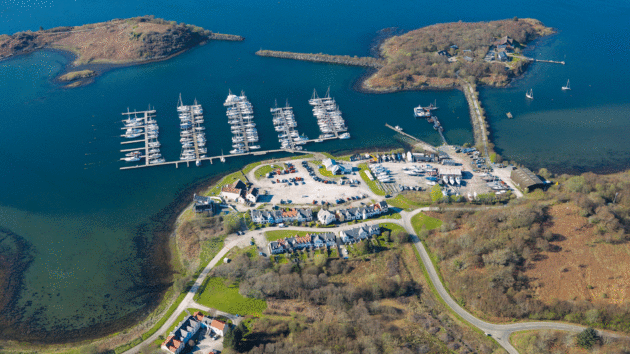
Craobh Marina which the Norton family are trying to develop without losing its sense of place. Photo: Craobh Marina
“One of the things we’ve realised over time is that all of our sites need to be close to a boatyard and fuel, so when things go wrong, things can get fixed easily, allowing more time on the water. For owners, that’s often what matters most in the end.
“It’s no good having a beautiful berth if every time something needs attention turns into a complicated exercise. If the services and support are there, then ownership feels much easier,” says Lewis.
Owners may choose berths based on atmosphere, convenience or scenery, but many later discover that what matters most is how straightforward the practical side proves to be.
Lewis also sees marinas broadening their role ashore as well as afloat. “We’re now hoping to appeal to those without boats as well,” he says. “We’ve realised that people who hang around marinas often end up afloat themselves, eventually. That may be through clubs, shared ownership, lessons, or just spending time in and around the waterfront and deciding that they want to become part of it.”
Beyond the berth
Noss on Dart is a prime example in Premier’s network. The marina sits on the River Dart in an environmentally sensitive location, and Lewis says that has shaped the whole approach to the site.
“It had to be developed very sensitively because of where it is,” he says. “It’s a very special setting and there’s a strong expectation that if you’re going to make that level of investment, the result has to be a net good. It has to improve what is there, not just enlarge it. We are thinking about the project as a whole rather than just berth-holders.
“A lot of people don’t realise that Premier Marinas is owned by the Wellcome Trust,” Lewis adds. “We are a for-profit enterprise, but the ultimate beneficiary is charitable good. At Noss that means not just creating better marina infrastructure, but also supporting the local area and making sure the development serves a wider purpose.”
The site combines marine services with a berth-holder lounge, café, commercial units, accommodation and training space. Lewis also points to the rise of clubs and shared ownership, still more common in motor yachting in the UK but likely to become more familiar in sailing too.
“Cost sharing is appealing to people, and we think those models are likely to become more commonplace. That changes the way marinas have to think, because the berth is serving a slightly different pattern of use. More handovers, more varied arrival times, more need for things to work outside normal office hours.”
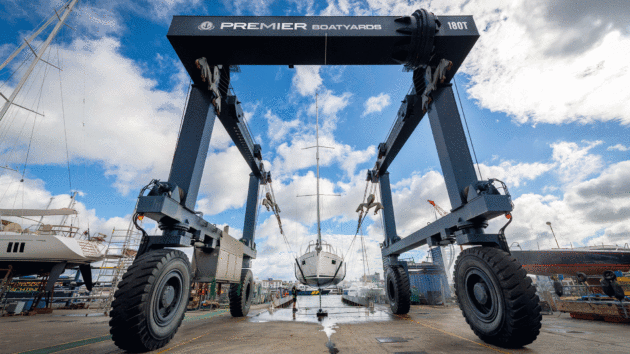
Lift at Endeavour Quay Boatyard, Gosport. Photo: Premier Marinas
We bought a marina
The Norton family are sailors who have spent years making landfalls in different harbours, learning in practical ways what makes a marina work. On their return to the UK they didn’t just buy a berth: they bought the whole Craobh Marina on the West Coast of Scotland.
They describe their nine-year circumnavigation aboard their Oyster 56 Miss Tipp as a family undertaking in which everyone stood watches, learned together and the experience was shared. Now, they are applying the same approach in a rather different setting ashore at Craobh.
Sheila Norton highlights the setting because it is impossible to ignore. “Craobh lies in a naturally sheltered fold of the west coast, with steep hills rising behind and open cruising country beyond. It does not take much imagination to see how easily the wrong sort of marina development could spoil it, and that sits at the centre of our thinking. We’re very conscious that the setting is a huge part of what makes Craobh special,” she says.
“It would be very easy to overdo a place like this, and that is not what we want. People come here because of the landscape, because of the sense of shelter, because it feels part of the coastline rather than imposed on it. So, for us the question is not just what can be added, but what should be added, and how do you do that without losing the very thing that makes the place attractive in the first place?”
Sense of belonging
Brian Norton says the starting point was straightforward. “Before you start talking about the pub, or events, or any of the wider plans, you have to know the marina itself is sound. We’ve invested in new pontoons and in making the berths more secure with new underwater concrete blocks. On this coast the weather can be rough, so it has to be good.
“It’s not glamorous work, but it’s the sort of thing that matters to owners. If you’re trusting a place with your yacht, those basics have to be right.
“But, at the same time, we’ve chosen to run it as a marina without a gate, which was deliberate. We want people to feel they can come in, visit, and that it’s part of the wider place rather than something cut off from it. It’s wild, it’s beautiful, and it would be a mistake to turn it into something generic.”
Essential elements
The Lord of the Isles pub next door, which the family also took on, is part of that wider concept. “For the local community, the pub is hugely important,” Brian says. “Of course visiting crews want somewhere to go ashore, but it matters just as much that local people have somewhere to gather. A marina like this doesn’t exist in isolation. It sits in a real community, and if you want the place to thrive that has to be part of the thinking.”
A lot of the family’s ethos comes from their own years afloat. “Even when you’ve got a comfortable yacht like the 56, when you make landfall you want the same basic things.
“You want a really good shower. You want somewhere to wash kit and clothes properly. You want to be able to sort yourself out after a passage and reset a bit,” he says.
“But what stays with you just as much is the human side of it. You want a welcome smile, somebody there to help with the lines, and a feeling that you’re actually welcome at the place you’ve arrived.”
Finding the right berth: Lease berth basics
- Buying a lease berth in the UK can be more structured than many owners expect. Triangle Berth Brokers notes that some sales involve Land Registry, with formal documentation and title records.
- Allow around 6-10 weeks from deposit to completion in many cases.
- A bought berth is usually leasehold rather than freehold, so one of the key things to check is how many years remain on the lease.
- In some marinas, leaseholders can sublet their berth when they are away cruising, which can make ownership more flexible.
- The purchase price is only part of the picture, so it is worth checking annual service charges, legal costs and any taxes that may apply.
- In busy marinas, a lease berth can also offer valuable certainty, securing a base in the place you actually want to keep the yacht.
Three to consider
2005 Najad 380 Elva – £185,000 ex VAT
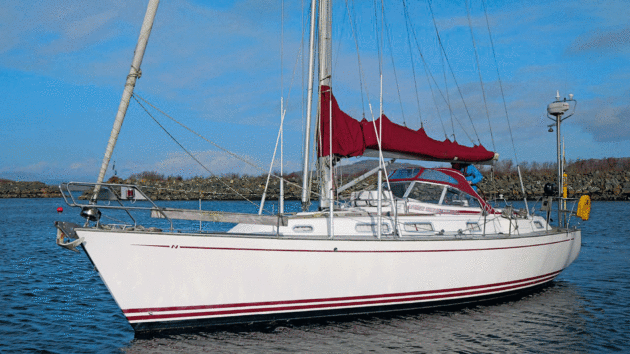
2005 Najad 380 Elva. Photo: Mark Cameron Yachts
Though lightly used this yacht comes with an impressive inventory including Raymarine electronics and autopilot, Eberspächer heating, liferaft and EPIRB, standing rigging replaced in 2022. Lying Craobh Marina. mcyachts.co.uk
2005 Malo 40, Ziggy – £215,000
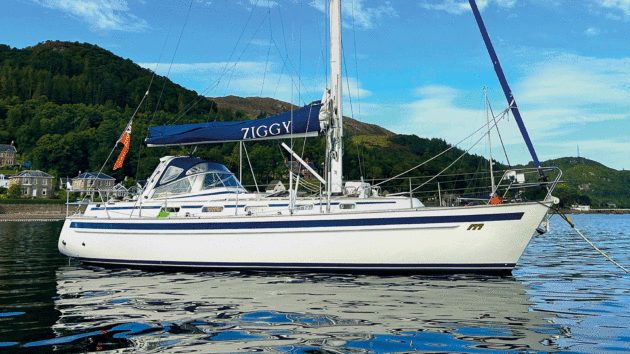
2005 Malo 40, Ziggy. Photo: Mark Cameron Yachts
This single-owner Malo 40 has regularly cruised the west coast of Scotland as well as trips to Ireland and the south coast of England. Many upgrades including Eberspächer heating, full standing rigging and domestic batteries replaced 2025/26. Lying Largs. mcyachts.co.uk
2007 Contest 45CS, Fly – £299,950 tax paid
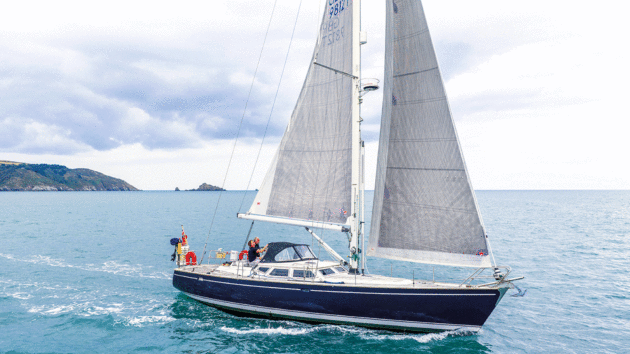
2007 Contest 45CS, Fly. Photo: Ancasta
Centre-cockpit, fin keel, twin cabin example of this bluewater-capable cruiser. Inventory includes in-mast furling, Raymarine electronics, watermaker and Coppercoat. Lying Dartmouth. ancasta.com
 If you enjoyed this….

Yachting World is the world’s leading magazine for bluewater cruisers and offshore sailors. Every month we have inspirational adventures and practical features to help you realise your sailing dreams.Build your knowledge with a subscription delivered to your door. See our latest offers and save at least 30% off the cover price.
Note: We may earn a commission when you buy through links on our site, at no extra cost to you. This doesn’t affect our editorial independence.
The post How to find the right berth for your yacht: what to look for in a marina appeared first on Yachting World.