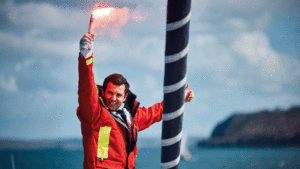
Sailing around the world the ‘wrong’ way round: ‘The direct route is 22,000 miles. I’ve done 37,000!’
Guirec Soudée obliterated a very rare sailing record when he raced around the planet alone, against the prevailing winds. Francois Tregouet found out why.
Sailing around the world solo, through the Southern Oceans, remains one of the sport’s purest challenges. Doing so the ‘wrong way’ round – westabout, against the prevailing weather systems – is rightly regarded as a Herculean task, in the sphere of climbing Everest without oxygen. French adventurer Guirec Soudée is only the sixth person to ever achieve it – half the number of people who have walked on the moon.
“It remains one of the toughest challenges in offshore sailing,” explains Dee Caffari, who became the only female sailor ever to complete it in 2006.
“It’s less about speed and more about endurance, determination, and mental strength. It is relentless. The conditions wear you down and test you beyond any level you can imagine.”
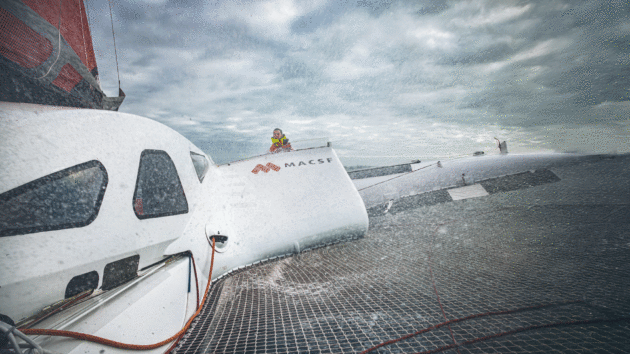
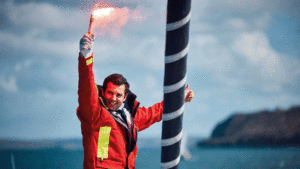
Photo: Armel Vrac/MACSF
No previous sailor had even come close to achieving it in a multihull. When Soudée crossed the finish line off Ushant this March, he demolished a record which had stood for over 20 years, on a boat that many believed was eminently unsuited to the task: a 32m (104ft) trimaran.
It’s perhaps not surprising that the slightly outlandish challenge appealed to the 34-year old Breton. Soudée first sprang to public attention when he completed a five-year 40,000-mile expedition in his early 20s, alone apart from a chicken called Monique.
While the novelty of Soudée’s companion captured public imagination, the voyage itself was remarkable: two Atlantic crossings, a Northwest Passage (including 130 days ice-bound off the coast of Greenland), and a Cape Horn rounding, on a low budget 30ft steel yacht called Yvinec.
He went on to compete in the 2024/25 Vendée Globe (finishing 23rd on Freelance.com). A Vendée is usually considered the pinnacle of solo racing, but Soudée was already looking beyond it.
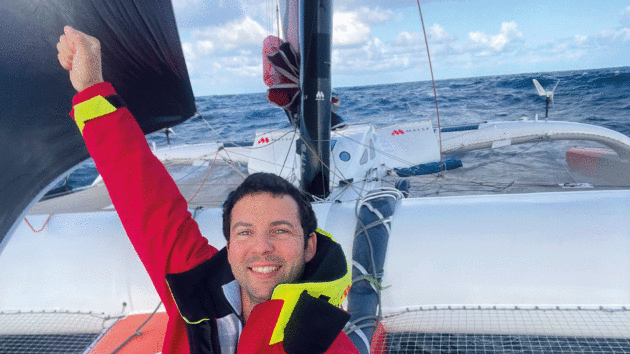
Soudée celebrates as he crossed the virtual line off Ushant on 28 March, smashing the 100-day barrier for a solo westabout around the world. Photo: Guirec Soudée/MACSF
“On my return from the CIC Transat, whilst I was sailing from New York to Lorient, I was thinking about what I was going to do after the Vendée Globe,” he recalls. “I couldn’t really see myself setting off on another Vendée, doing a sort of copy-and-paste of the first one on the same type of boat.
“I’d been thinking about the round-the-world race in reverse for quite some time because it seemed like a real adventure to me, with Jean-Luc Van Den Heede as my inspiration. I’m more of an adventurer than a competitive sailor, so this project was perfect for me, especially with the pioneering aspect of sailing a multihull, as several others had tried but failed. Switching to a large multihull like an Ultim trimaran – that really excited me.
“That said, I knew it was an ambitious project. These boats are hard to find, and expensive to buy and maintain, because they’re so complex.”
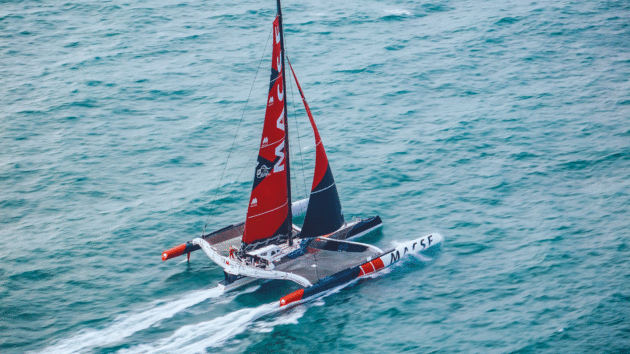
‘The day I set off was the first time I’d been alone on this boat’. Photo: Armel Vrac/MACSF
Right boat for the job
The trimaran Soudée set out to purchase was originally Geronimo, built in 2001 for Olivier de Kersauson, and subsequently reworked for Thomas Coville as Sodebo (on which Coville set a solo eastabout record in 2016 of 49 days). But getting the project off the ground was not easy.
“I didn’t have a partner who could buy the boat, so I had to sort things out with the banks on my own. It took a very long time because these boats are fragile and prone to capsizing, especially on this particular route, so I understand why the banks were cautious. Afterwards, I was lucky enough to find some great partners who enabled me to get ready, even with a modest budget compared to what’s usually spent in the Ultim class.
“We’re currently on a budget on a par with an average IMOCA project,” he notes.
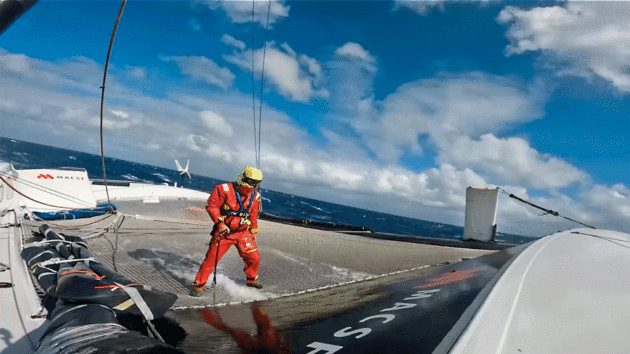
Just a handful of skippers have ever sailed a giant Ultim non-stop around the world – none have even come close to completing it west-bound. Photo: Guirec Soudée/MACSF
“But the great thing about this boat is that it’s very well-built, even though it was pretty worn out from its previous round-the-world trip. So we had a huge amount of work to do: replacing all the running and standing rigging, overhauling, modernising, installing a lot of electronics, replacing all the sails… My plan was to set off only if I had a boat capable of seeing it through to the end.
“I knew it was going to be tough, and although I was confident because I know the ocean well, I had less experience with multihulls. Even though I’d trained well, I knew I’d face tricky conditions I’d never encountered before. The day I set off on this round-the-world trip was the first time I’d been alone on this boat. So I was only half at ease, and I knew that if I didn’t bring the boat back, financially it would be a struggle.”
Soudée, supported by his technical team, prioritised reliability in MACSF’s refit and preparations. “For example, we had solar panels, two wind turbines, a hydro-generator and an engine, and I asked for a generator to be added.
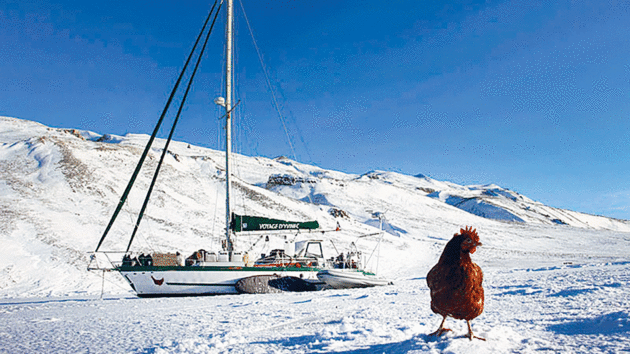
You may remember Soudée sailed around the world with Monique the red hen. Photo: Guirec Soudée
“The same goes for the sails. It wasn’t mandatory to have a J4 or to use new sails, but the sails are the power. When people told me, ‘It might just do the job,’ I wouldn’t accept that ‘might’.
“We also decided to replace the T-shaped rudders with straight rudders. The foil rake wasn’t working properly, so we scrapped it. I really wanted the boat to be as simple as possible, even though it remains a true Ultim with a rotating, canting mast and a lot of hydraulics on board.
“Everyone – whether it was Yves le Blévec, Thomas Coville, or Jean-Luc Van Den Heede – told me it was the best boat for the round-the-world trip in that direction, because it’s very robust.”
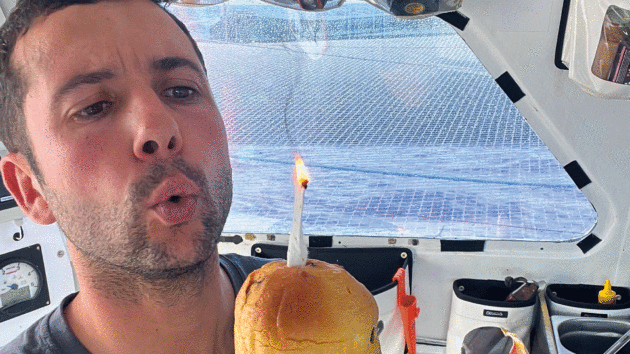
Celebrating his 34th birthday at sea, doing 25 knots off the coast of Salvador de Bahia. Photo: Guirec Soudée/MACSF
An unassailable lead?
Soudée started on 23 December 2025 and enjoyed an incident-free track south down the Atlantic, 1,000 miles ahead of Van Den Heede’s record at the Equator and 2,000 at Cape Horn.
But rounding the Horn west-bound in a trimaran is a significant test: two westabout attempts had foundered there in 2017 and 2022 (solo skipper Yves le Blévec capsized and the double-handed pairing of Romain Pilliard and Alex Pella ran aground while storm bound. All were safely rescued).
For his entry into the Pacific Ocean, MACSF faced 40-knot winds and 5m seas. “I knew the conditions were going to be bad, with sustained wind, but above all a very bad sea, which put the boat, and inevitably me, to the test,” Soudée blogged shortly after. “Because in conditions like these, it’s difficult, even impossible, to rest, and naturally there’s quite a bit of tension on board!
“Even though it’s not really my style to be stressed, I knew that everything could stop very quickly. So I’m happy and relieved.”
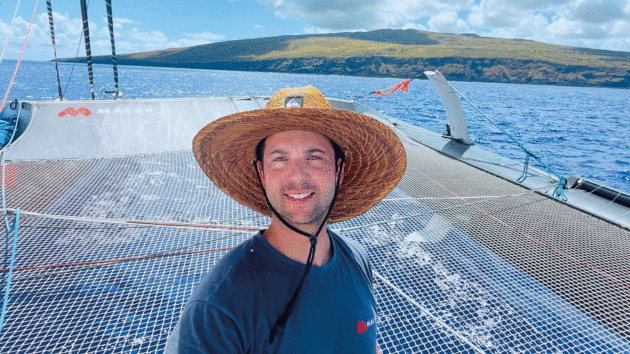
Within touching distance of Easter Island in the Pacific. Photo: Guirec Soudée/MACSF
After rounding Cape Horn, he stuck close to the Chilean coast for 1,000 miles before striking north-west and passing close to Easter Island – a highlight for the natural explorer.
At 27° South, Easter Island is well away from the worst headwinds. Instead Soudée had predominantly south-easterly tradewinds, so he nudged up into the tropical latitudes. At his most northerly in the Pacific, he was less than 500 miles south of the Equator as he passed the uninhabited island of Eiao, part of the Marquesas in French Polynesia.
From here his route took MACSF north of Tahiti and even north of New Zealand, all in generally favourable winds and for a period also pushed along by the South Equatorial Current. Crossing the Tasman Sea and approaching the Bass Strait things got more dicey with strong winds and a confused sea state.
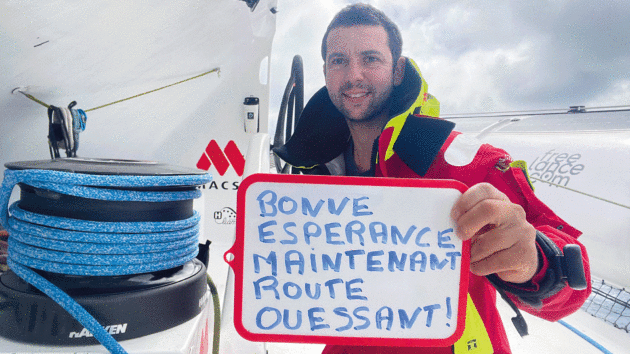
Rounding the Cape of Good Hope on his return to the Atlantic. Photo: Guirec Soudée/MACSF
“I also encountered bad weather and quite strong headwinds off Australia,” he recalls. “The plan was to find the best routes with the help of Christian Dumard, to try and avoid close-hauled sections as much as possible, and stay on courses suited to this type of boat. So I had to head way up north, which we hadn’t planned at all.
“It’s tough mentally because you round Cape Horn 2,000 miles ahead of schedule, and then it all goes to waste by taking a course that has nothing to do with the direct route, until you’re 1,000 miles behind! The direct route is 22,000-24,000 nautical miles; I’ve done 37,000! The risk of hitting something is therefore much higher, and in terms of anxiety, it’s really not comfortable.”
After Cape Leeuwin and into the Indian Ocean, with favourable winds and currents MACSF averaged 500 miles a day for almost a week. But as he started to edge further south Soudée’s path was blocked by Category 5 cyclone Horacio, forming below Madagascar, with winds of up to 155kts forecast.
In typically understated terms he explained: “I have two options, either going straight into it, having stories to tell, and a movie! Or Option B, to go north of the hurricane. It might be the right option!”
Article continues below…
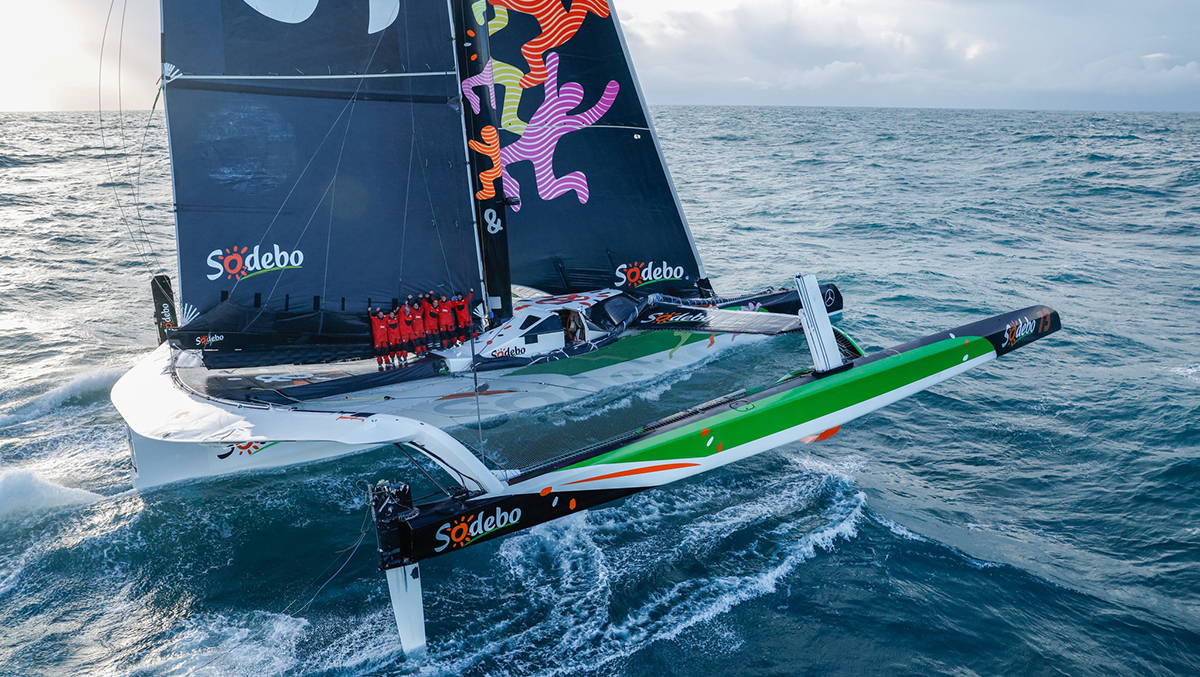
Around the world record broken: Sodebo takes Jules Verne Trophy in 40d 10h 45m
Thomas Coville’s Sodebo team crossed the virtual finish line between Ushant and Lizard Point this morning at 0746 (French time),…
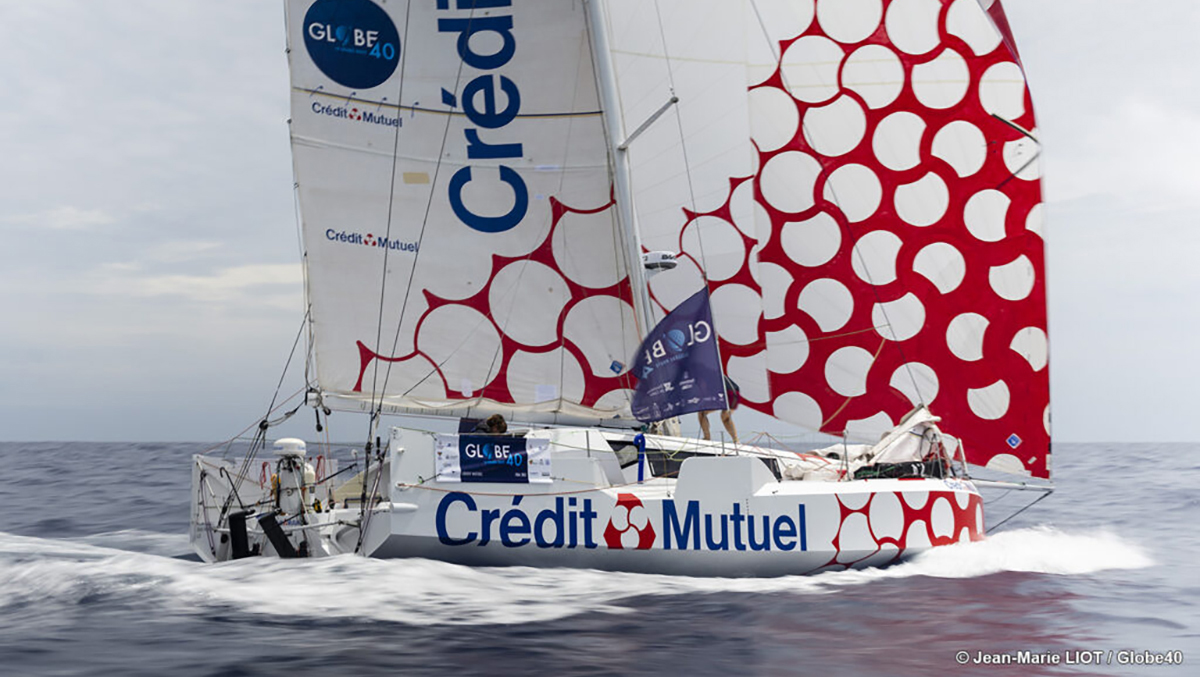
What it’s like racing double-handed around the world in a 40-footer
We are deep in the South Atlantic on a screaming reach, riding the leading edge of the semi-permanent cold front…
Building fatigue
Though he had avoided boat-breaking conditions, Soudée was having to work hard to keep on top of technical problems. “I had some issues, but I managed either to deal with them or to anticipate them by doing daily inspection rounds and spotting what was wrong before it got any worse. The boat still took a real beating for a long time; I took a real beating, even though I was trying to slow down as much as possible.
“Even before Cape Horn, I suffered damage to the starboard foil, which was out of action by the end of the Atlantic descent. The most serious problem was the issue with the starboard rudder just before Africa,” he recalled.
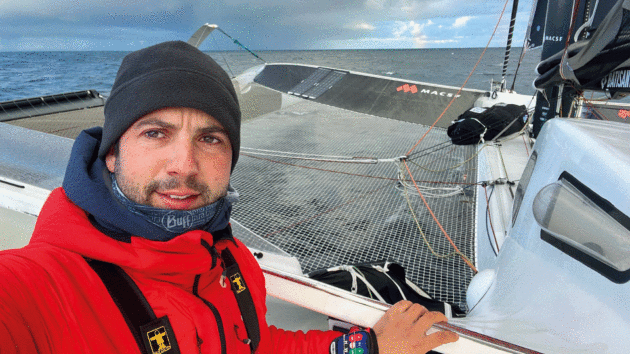
Readying for a major front ahead of a forecast 35-50 knots, with a triple reefed main and J4. Photo: Guirec Soudée/MACSF
MACSF hit discarded fishing gear at 20 knots, ripping a chunk out of the rudder. “I was inside the boat, I wasn’t going super-fast, about 20 knots,” he reported at the time.
“I felt a shock, then two. I headed downwind straightaway, slowed the boat down as much as I could, and realised I had hit something. I switched the pilot off and took the helm manually but it was really hard and the boat would not accelerate. Then I realised that the starboard rudder had a fishing net around it with heavy weights on each end.”
He disentangled the rudder, but the boat was compromised. “It was a major hindrance because, on a port tack, as soon as the boat accelerated the rudder would stall, so I was forced to reduce speed; otherwise it became extremely dangerous. I couldn’t go over 20 knots, and with these boats you reach that speed very quickly, so it was a real setback. But I was still lucky that it held out until the end.”
Physically Soudée was also feeling the effects of exhaustion. “That’s what surprised me most compared to the IMOCA class, which demands a lot of attention. But there are moments when you can still relax and take a breather. On the Ultim, there wasn’t a single moment when I had a moment’s peace, when I could recover.
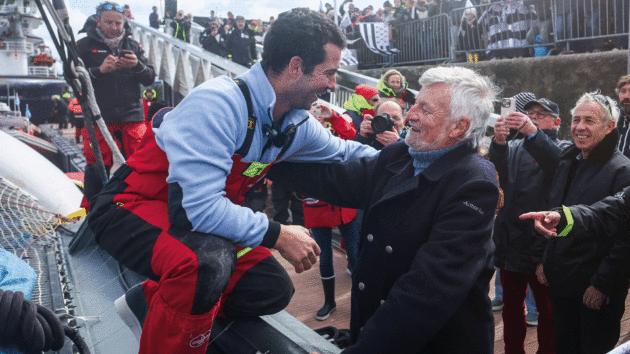
Soudée being congratulated by previous record holder Van Den Heede. Photo: AFP via Getty Images
“When it wasn’t bad weather, it was cargo ship traffic, fishermen, islands, squalls… I was on my toes the whole time and it really wore me out.
“The extremely heavy traffic off the coast of South Africa – like when I sailed along the coasts of Polynesia and Australia – were all moments when you have to stay fully focused. You can’t rest at all.
“The hardest thing for me was really managing my sleep, which is still disrupted today.”
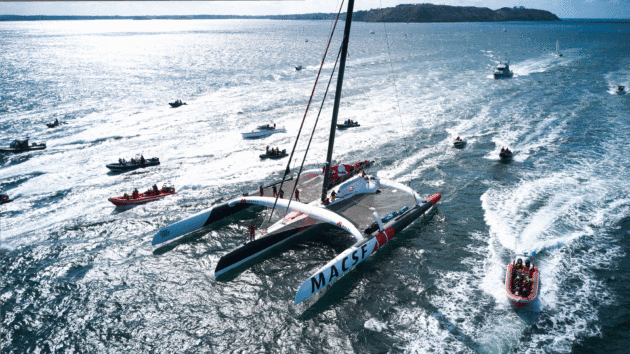
Photo: Anne Beauge/MACSF
Adventure above all
Despite the additional traffic, conditions around the Cape of Good Hope were relatively benign and MACSF re-entered the Atlantic an incredible 3,700 miles ahead of Van Den Heede’s record.
Soudée was able to put in more 450-mile days in the North Atlantic and – unlike the earlier Jules Verne finishers – there were no major North Atlantic lows to disrupt the final stage. “I’m not there yet, even if Brittany has never been so close, now is when the boat starts to tire, and me too to be honest,” he blogged.
At 0834UTC on Saturday 28 March, MACSF crossed the line between the Lizard and Ushant, with an elapsed time of 94 days, 21 hours and 58 minutes. Brest turned out in force, a flotilla of RIBs and small boats following him into harbour, where the quaysides were crammed with supporters, many waving the black and white Breton flag of their local hero.
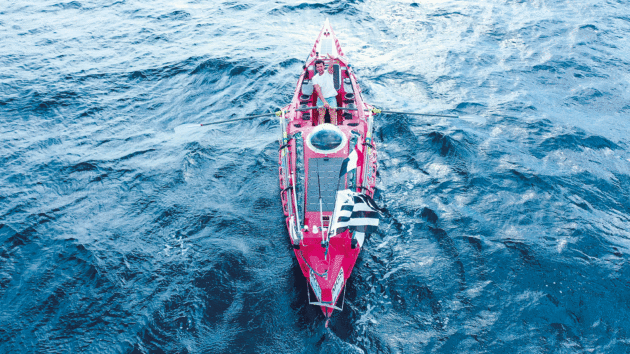
Soudée has also rowed solo across the Atlantic. Photo: Guirec Soudée
The achievement can’t be understated. Caffari – the only sailor ever to have both raced around non-stop on an Ultim and westabout solo – understands more than anyone how challenging it is to complete a singlehanded around the world the wrong way in trimaran.
“It is immensely impressive,” she says. We saw the incredible footage of when he first rounded Cape Horn and how horrendous the sea state was – on a multihull the sea state is everything. He wisely headed north to more manageable conditions and people questioned what he was doing. As we soon learned, the speed he can so easily attain on a multihull meant that the extra distance sailed was easy to make up.
“He has now set a new benchmark for a westabout circumnavigation that I suggest will stand for a long time to come, and he has joined a very small number of us that have sailed a solo, non-stop westabout. I celebrate his achievement and welcome him to our elite group!”
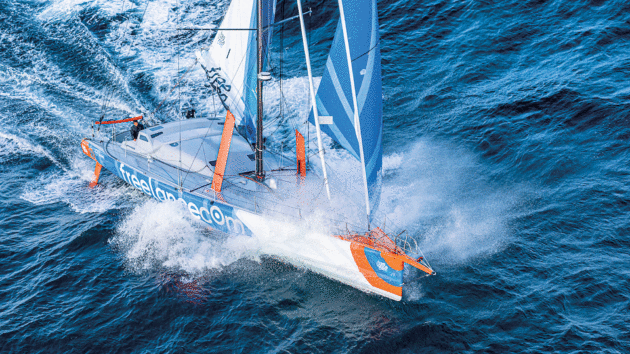
Soudée competed in the 2024 Vendée Globe. Photo: Eloi StichelbautVG2024
off the beaten track
Looking back at his many adventures, what does Soudée think connects them? “For me, the common thread is adventure above all else – the adrenaline, the desire, pushing myself… It’s really a combination of things I wouldn’t find in other projects or other disciplines.
“I need these different projects that are a bit off the beaten track. The idea isn’t just to do things differently from others, but to do things that appeal to me and don’t appeal to many people.
“People asked me why I was embarking on such a project when the success rate is so low. And it’s true that when you reach Cape Horn, you think of all the people who tried before you in multihulls and didn’t make it – in particular Yves le Blévec, with all his experience and being so well prepared, you wonder why it would work for you if it didn’t work for him? But in the end, it did. The idea is to just do things without overthinking them.”
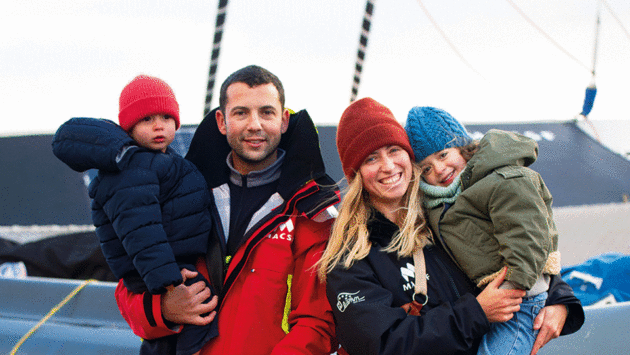
Soudée next plans to cruise Greenland with his young family. Photo: Likka/MACSF
For Soudée, even downtime is an adventure.
“After completing the Vendée Globe and a round-the-world race in the opposite direction, I’m trying to settle back into normal life. Two world trips in just over a year took quite a lot out of me. So this summer we’re setting off as a family, with my children aged 2 and 4, to sail around Greenland for two months, and it’s brilliant. I’m absolutely delighted to be able to take them to an extraordinary place that has left a lasting mark on my life.”
After that, he plans to be back on his Ultim, for a Route du Rhum this winter, then perhaps another world tour. “The Arkéa Ultim Challenge 2028 is an adventure that really appeals to me. Sailing round the world in the right direction at full speed downwind must be pretty brilliant!”
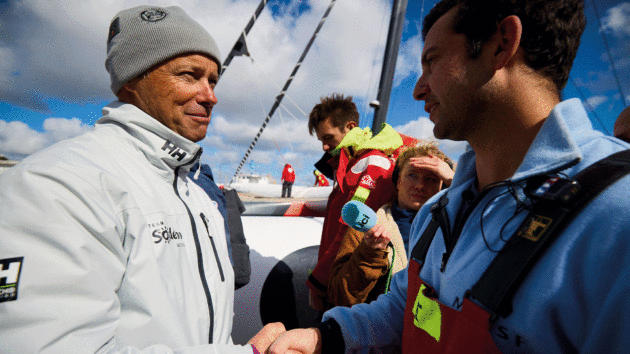
Soudée being congratulated by Coville after finishing in Brest. Photo: Anne Beauge/MACSF
Westabout records
Chay Blyth 1971 – 292 days
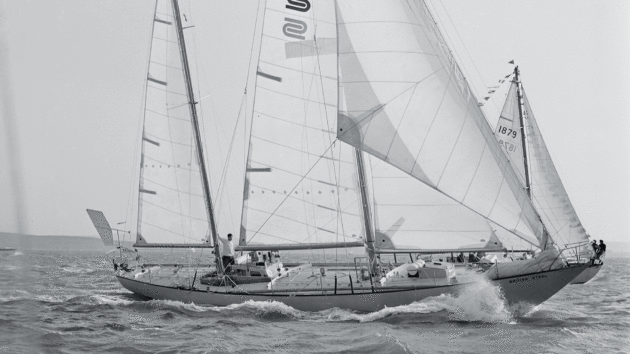
British Steel. Photo: Getty Images
Blyth first sailed single-handed around the world westabout in the steel ketch British Steel, and later launched the British Steel Challenge/BT Global Challenge for amateur crews to also race around the world the ‘wrong way’.
Mike Golding 1994 – 161 days
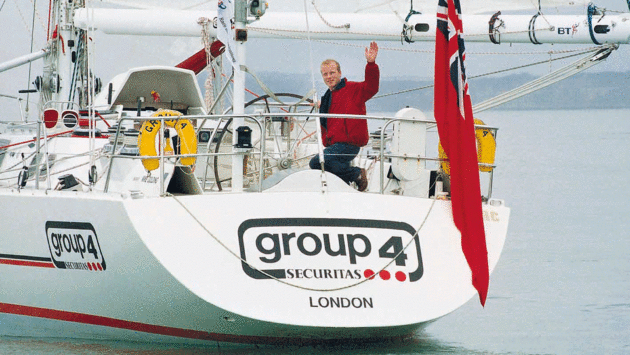
Team Group 4. Photo: Alamy Stock Photo
Global Challenge skipper Golding bettered Blyth’s record in one of the Challenge yachts, Team Group 4, 23 years later.
Philippe Monnet 2000 – 151 days
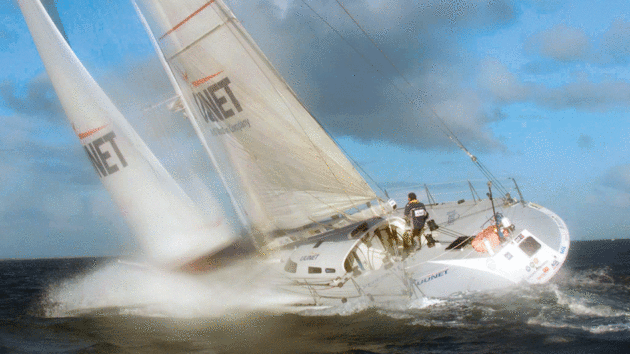
Uunet. Photo: AFP via Getty Images
French skipper Monnet bucked the ‘metal boat’ rule by setting a new record in an Open 60 Uunet.
Jean-Luc Van Den Heede, 2004 – 122 days
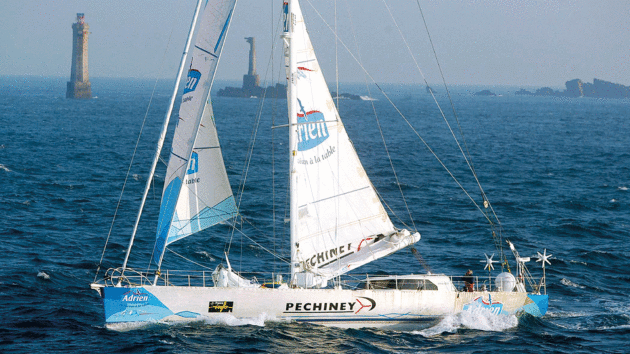
85-footer Adrien. Photo: AFP via Getty Images
Van Den Heede set a record that stood for 22 years, on his fourth attempt in the aluminium 85-footer Adrien.
Dee Caffari, 2006 – 178 days
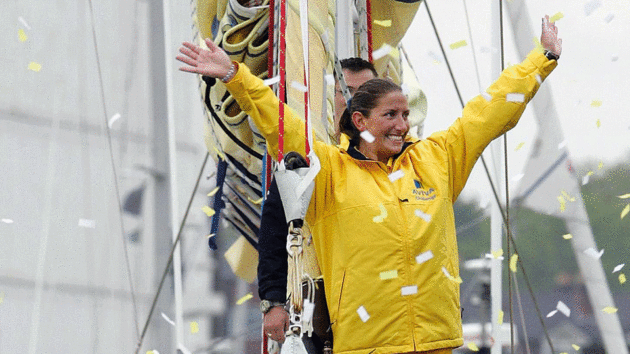
Dee Caffari. Photo: POOL/AFP via Getty Images
Caffari’s successful westabout circumnavigation in Aviva, also a Challenge 72, set a benchmark women’s time that still stands. “In a world where there are very few firsts left to attain, I wanted to be that person,” Caffari recalls.
Guirec Soudée, 2026 – 94d 21h 58m 34s
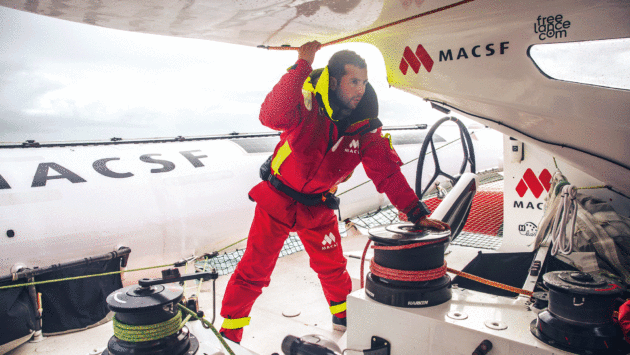
Guirec Soudée. Photo: Armel Vrac/MACSF
 If you enjoyed this….

Yachting World is the world’s leading magazine for bluewater cruisers and offshore sailors. Every month we have inspirational adventures and practical features to help you realise your sailing dreams.Build your knowledge with a subscription delivered to your door. See our latest offers and save at least 30% off the cover price.
Note: We may earn a commission when you buy through links on our site, at no extra cost to you. This doesn’t affect our editorial independence.
The post Sailing around the world the ‘wrong’ way round: ‘The direct route is 22,000 miles. I’ve done 37,000!’ appeared first on Yachting World.